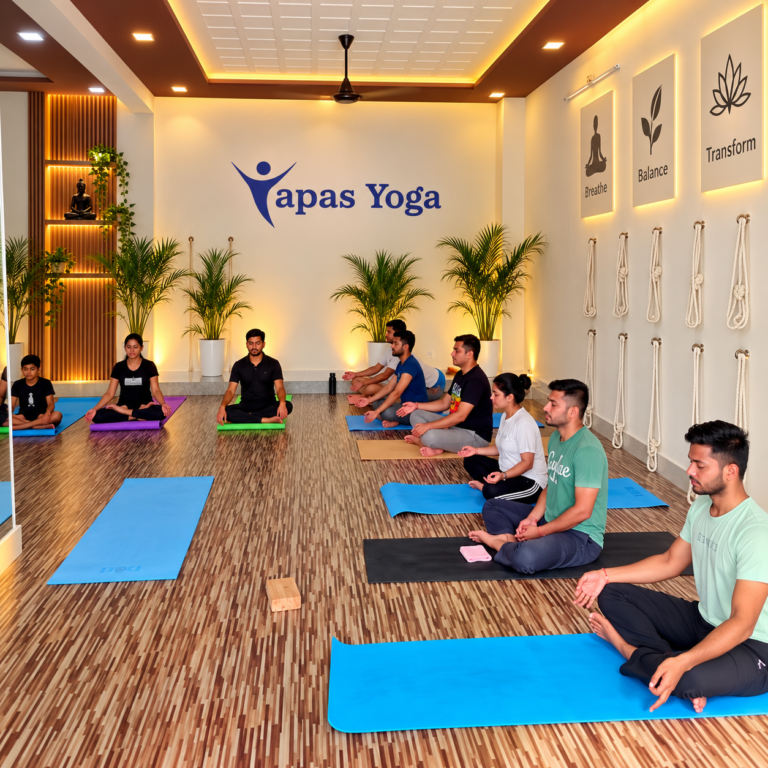
What Is Tapas According to Philosophy? Meaning & Benefits
What Is Tapas According to Philosophy? Meaning, Benefits & Daily Practice
What is tapas, have you ever known exactly what you should do for your health, but still found it difficult to do it regularly?
You know you should exercise, eat better, sleep on time and take care of your body. However, knowing something and actually doing it every day are two different things.
This is where the concept of Tapas becomes important.
In Yoga philosophy, Tapas is connected with discipline, commitment, self-control and consistent effort. In simple words, it means continuing your practice even when you don’t always feel motivated.
As a Yoga teacher, I find this concept very practical. After all, many people don’t struggle with knowing what to do. Instead, they struggle with consistency.
So, what exactly is Tapas? And more importantly, how is it connected with Ayurveda?
What Does Tapas Mean?
The Sanskrit word Tapas comes from the root Tap, which is associated with heat, burning or generating heat.
However, this “heat” does not simply mean physical heat. In Yoga philosophy, it can be understood as the inner effort that helps us transform ourselves.
Tapas means developing the discipline to do something consistently for our growth, even when it is not always comfortable or convenient.
For example, imagine that you decide to practice Yoga every morning.
Some mornings, you will feel energetic and ready to practice. On the other hand, there will be mornings when you simply want to stay in bed.
When you still get up and practice because you have made a commitment to yourself, you are practicing Tapas.
Is Tapas an Ayurvedic Concept?
There is an important distinction here.
Tapas is primarily a concept from Yoga philosophy, rather than an exclusively Ayurvedic concept.
In Patanjali’s Yoga Sutras, Tapas is one of the five Niyamas:
- Shaucha – Purity
- Santosha – Contentment
- Tapas – Discipline and dedicated effort
- Svadhyaya – Self-study
- Ishvara Pranidhana – Surrender to the Divine
At the same time, the practical idea of disciplined living has a strong connection with Ayurveda.
Ayurveda emphasizes appropriate food, daily routine, physical activity, sleep and balanced living. Therefore, when we connect Tapas with Ayurveda, we can understand it as the discipline required to maintain healthy and appropriate lifestyle habits.
Tapas and Agni
Ayurveda gives great importance to Agni, commonly understood as digestive or metabolic fire.
Interestingly, Tapas also carries the idea of inner heat or fire. However, Tapas and Agni are not the same concept.
They are different ideas. Nevertheless, the symbolism of inner fire can help us understand the connection between disciplined practice and traditional Indian approaches to health.
For instance, maintaining suitable meal timings, staying active, avoiding overeating and following a healthy routine can all be part of disciplined living.
Most importantly, the routine should be appropriate for the individual.
Tapas Does Not Mean Punishing Yourself
This is an important point.
Sometimes, people hear the word “discipline” and immediately think they have to push themselves harder. However, that is not necessarily what Tapas means.
Tapas does not mean starving yourself, exercising excessively, ignoring pain or forcing your body beyond its limits.
Instead, there is a difference between discipline and self-punishment.
For example, if your body needs recovery, taking appropriate rest can be the right choice. Similarly, if you are injured, modifying your practice can be wiser than pushing through pain.
Therefore, true discipline requires awareness.
Tapas in Everyday Life
You don’t need to perform extreme practices to experience Tapas.
In fact, you can practice it through simple daily habits.
Regular Yoga Practice
You don’t need to practice for two hours every day.
Instead, even 15–30 minutes of regular Yoga can become a practice of Tapas when you do it consistently.
Over time, this consistency can become more important than doing an extremely difficult session occasionally.
Mindful Eating
Choosing appropriate food and avoiding unnecessary overeating also requires awareness and discipline.
However, the goal isn’t to follow a perfect diet.
Rather, it is about making better choices consistently and understanding what works well for your body.
Waking Up on Time
If you’ve decided to wake up at a particular time but keep pressing the snooze button, you have an opportunity to practice discipline.
By getting up and starting your day as planned, you develop a small but meaningful habit of self-discipline.
Reducing Screen Time
This is especially relevant today.
You pick up your phone for five minutes, and suddenly half an hour has passed.
We’ve all experienced this.
Therefore, choosing to put the phone away and focus on your work, Yoga practice, family or sleep requires self-control.
In this way, even reducing unnecessary screen time can become a modern form of Tapas.
Tapas Is About Consistency, Not Intensity
This is one of the simplest ways to understand Tapas.
You don’t always need to do more. Instead, you need to do what you are doing consistently.
For example, someone who practices Yoga for 20 minutes every day may develop a stronger long-term habit than someone who does an extremely difficult session once every few weeks.
Similarly, the same principle applies to exercise, meditation and healthy eating.
As a result, consistency becomes more valuable than occasional intensity.
How Can You Practice Tapas?
If you want to start practicing Tapas, start small.
For example, choose one habit that you genuinely want to improve:
- Practice Yoga for 15 minutes every morning.
- Walk for 20 minutes every day.
- Practice 5–10 minutes of meditation.
- Sleep at a consistent time.
- Reduce unnecessary screen time.
- Eat your meals more mindfully.
Most importantly, choose something realistic.
Then, give yourself enough time to make it a habit.
And if you miss one day, don’t think you have failed. Instead, simply start again the next day.
After all, coming back to your practice is more important than being perfect.
Tapas, Yoga and Ayurveda
Yoga and Ayurveda are different traditional systems. However, they share many complementary ideas about disciplined and conscious living.
Yoga gives us the philosophical concept of Tapas.
On the other hand, Ayurveda gives us principles for maintaining health through appropriate diet, lifestyle, routine and balance.
Together, they remind us that our health is influenced not only by what we know, but also by what we practice every day.
Final Thoughts
For me, the most practical lesson of Tapas is simple:
Do what supports your wellbeing consistently, even when you don’t always feel like doing it.
You don’t need to change your entire life overnight. Instead, start with one small habit.
Practice it.
Repeat it.
Then, when you fall out of your routine, simply come back.
Ultimately, that is the spirit of Tapas—discipline, awareness and consistent effort leading to transformation.
About Tapas Yoga and Wellness Center
At Tapas Yoga and Wellness Center, we believe Yoga is more than physical exercise. Instead, it is a practice that can help us become more aware of our body, breath, mind and daily habits.
We offer Yoga classes, therapeutic Yoga, Power Yoga, personal Yoga sessions, flexibility and mobility training, and fitness-focused programs.
want to know more about tapas yoga and wellness center
Best Yoga Classes in Hanumangarh
Tapas Yoga and Wellness Center in Hanumangarh: Yoga Classes, Yoga Therapy & Personal Training